
The Great Disintegration
Our Lost Inheritance of Embeddedness
This piece is part of a six-part series drawn from my three decades of rural ecovillage living—an experiment at the edge of culture repair. These essays are living transmissions: collected field notes from both practical and cosmological investigations into the communal and land-based arts, and early previews from my upcoming book, Dying Together: The Art of Community Death Care—A Village-Inspired Guide to Belonging at the End of Life.
This series is meant to awaken what we already know: we belong to each other and to this living world. Reweaving ourselves into the web of life offers a blueprint for navigating both life and death. When we create containers rooted in belonging, death ceases to be an isolating, individual burden—it becomes a collective experience that deepens us.
I’m so glad you’re here.
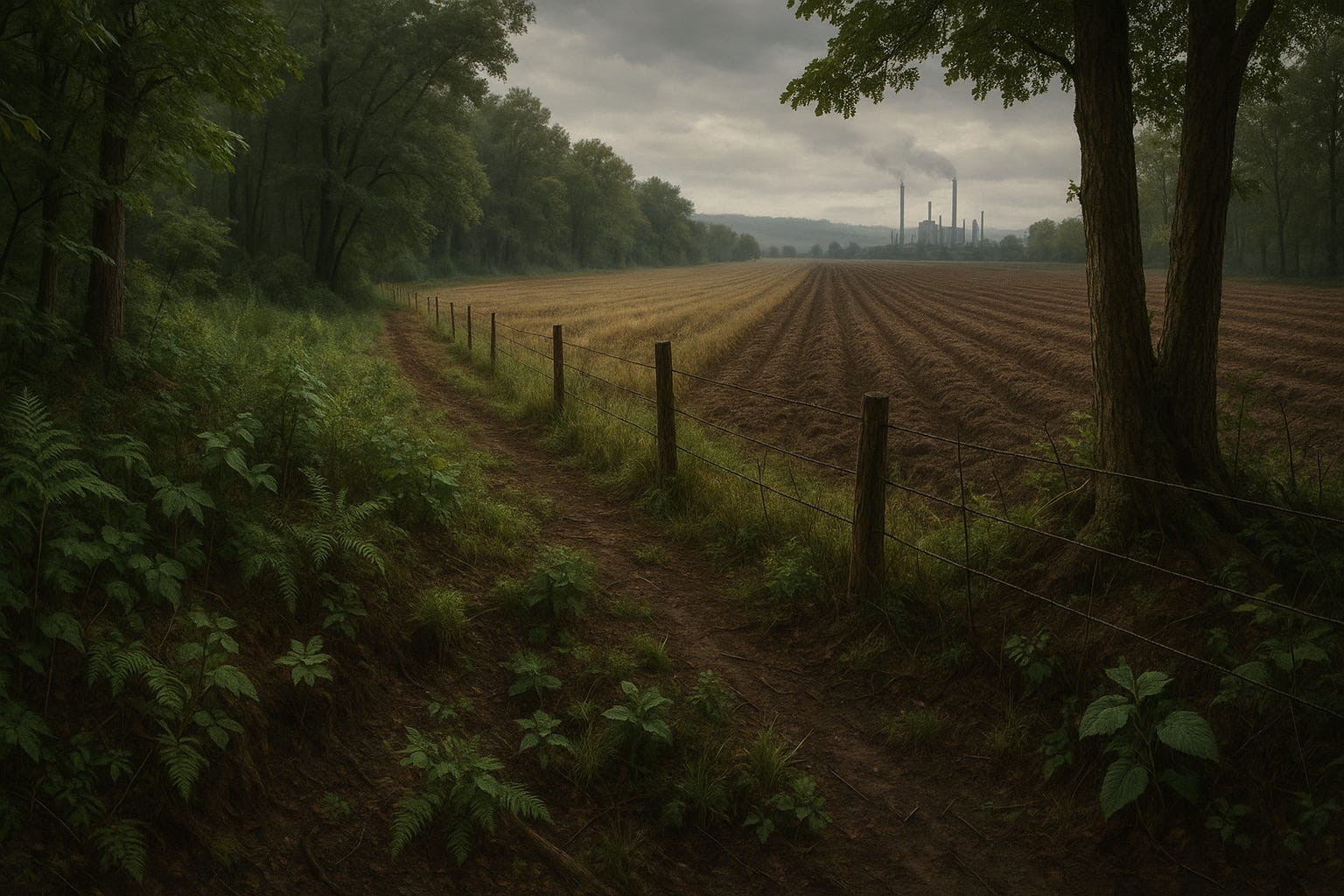
Paul Shepard, in Coming Home to the Pleistocene, describes prehistoric humans as “autochthonous,” meaning deeply and naturally embedded in their surroundings. They possessed knowledge passed through generations—knowledge of terrain, seasonal cycles, plants, and animals, all woven into a mythology that reinforced their belonging. To them, land was not a resource, but a relative, an ancestor, a home.1 Compare that to today, where most of us do not know the names of the trees that line our streets, let alone the medicines growing at our feet or even the type of fiber in our clothes. The world has become background noise, a commodity, something we pass through rather than something we belong to.
A closer timeline than prehistoric versions of us, gives us a stronger picture of the fractured lives most of us live. About 150 years ago, 90% of the U.S. population farmed—not just growing their own food, but managing forests for timber and fuel, harvesting fodder for livestock, making their own clothes, dipping candles for light, and a whole host of other things. Self-reliance was an embodied skill set. When my grandmother Rose was born in 1916, that number had dropped to 50%, as industrial goods and services increasingly replaced the work of human hands. By the time I was born in the late 1960s, only 30% of Americans farmed, and the slow drift away from land-based knowledge continued to accelerate. Today, as of 2023, just 1% of the U.S. population is directly connected to farming2 and most people wouldn’t know how to keep themselves or their families alive for more than a few days without grocery stores, electricity, and supply chains they’ve never had to question.
This amnesia is costly. We now depend on fragile industrial food systems, disposable products that pile up in landfills, and a medical model that treats symptoms rather than root causes. Worse yet, we are taught to believe that our suffering is personal—that depression, anxiety, and alienation are individual disorders rather than the natural consequence of a society built on disconnection.
The truth of our heartbreak is that we have lost the intimate, embodied knowing of how to live in place, and centuries of ancestral wisdom—teaching us how to be in reciprocal relationship with the living world—have been severed. As our physical skills have all but vanished—the ability to tend soil, identify plants, track the weather, and compost our waste—a part of our animal selves is left uncertain, disembodied, and disempowered in ways we barely understand. Yet the emotional, psychological, and spiritual consequences of this exile are just as profound. As “suburban and urban refugees,” we have been cut adrift from the land-base that once defined our reality, disconnected from the stewardship and shared responsibility that gave us purpose, and lonely for the interdependence that once embedded us in context. Without the grounding of place and tribe, we have become cosmological orphans, wandering through a world of artificiality, untethered from the rhythms and meaning that once shaped us. We are woefully lost.
This Substack is a meeting place for those tracking wild intimacy in all life, death, and everything in between. For those who feel the ache for something coherent. If these words echo something you’ve touched or longed for, I’d love to hear from you. The village is not a place. It’s a practice. Let’s return together.
Paul Shepard, Coming Home to the Pleistocene, edited by Florence R. Shepard (Washington, D.C.: Island Press, 1998).
United States Department of Agriculture (USDA), 2007 Census of Agriculture: Small Farms (Washington, D.C.: National Agricultural Statistics Service, 2007), USDA 2007 Census; USDA, 2012 Census of Agriculture: Farm Demographics (Washington, D.C.: National Agricultural Statistics Service, 2012), USDA 2012 Census; USDA, 2022 Census of Agriculture Highlights: Farm Producers (Washington, D.C.: National Agricultural Statistics Service, 2024), USDA 2022 Census.
Thank you!
so much beauty, yes